Philippines vs. Thailand: Transnational Eldercare Compared
Two countries. Two care cultures. One question: where will your parent receive the best care? This guide compares the Philippines and Thailand across the dimensions that matter most — cultural approach, staffing, infrastructure, visas, and cost — so your family can make an informed choice.
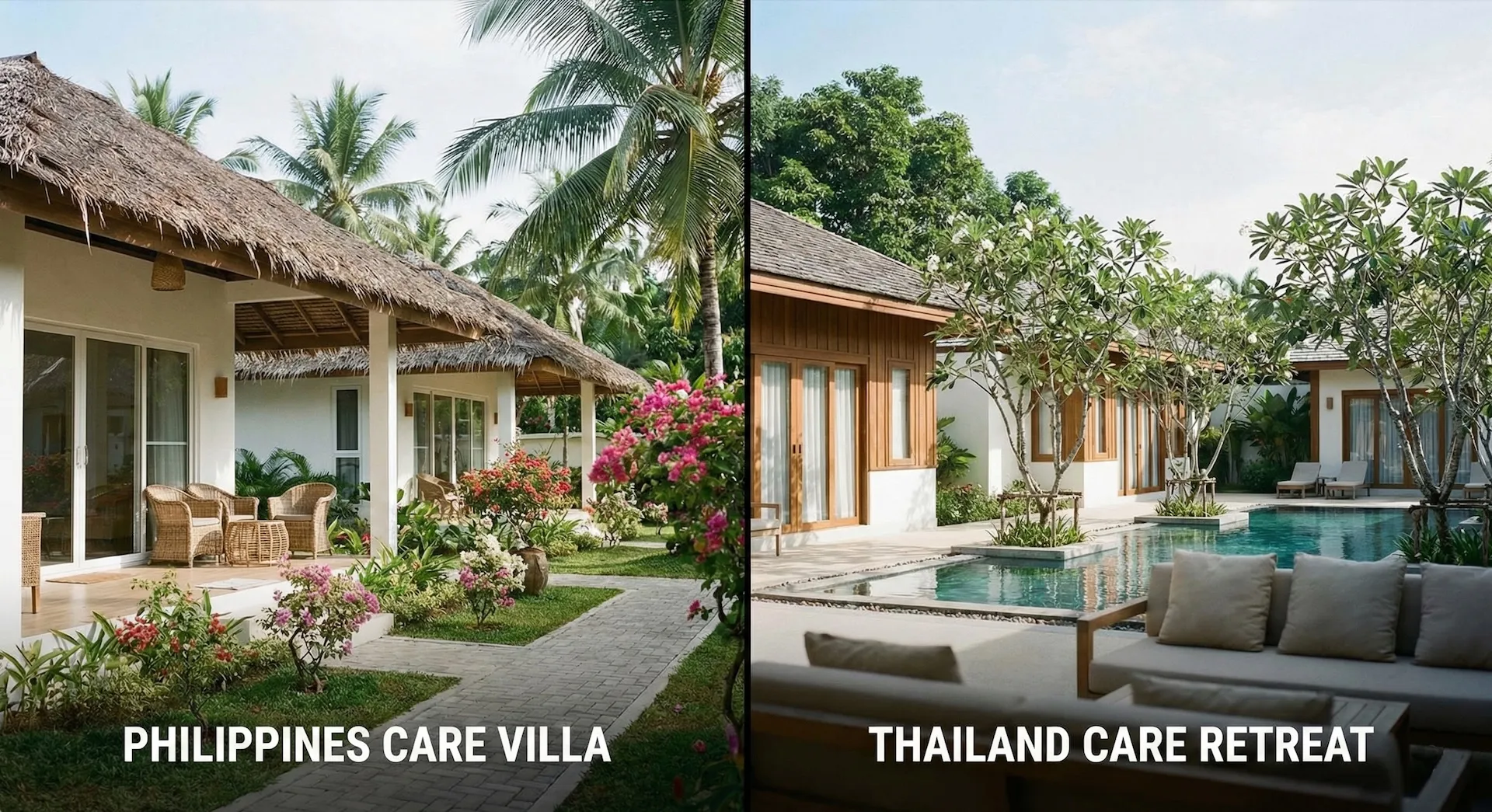
Quick Comparison
Before we dive into the details, here's a high-level snapshot of how the Philippines and Thailand compare across the key dimensions families care about.
| Dimension | Philippines | Thailand |
|---|---|---|
| Primary language | English (native fluency) | Thai (English varies by facility) |
| Cultural care concept | Malasakit (compassionate concern) | Nam jai (water from the heart) |
| Typical staff ratios | 1:1 to 1:5 | 1:1 to 1:4 |
| RN role | Direct hands-on care | Direct hands-on care |
| Monthly cost range | $1,200–$3,000 | $1,500–$4,000 |
| Retirement visa | SRRV Classic (from $15,000 deposit) | O-A visa or LTR ($600K+ assets) |
| JCI-accredited hospitals | 14+ | 62+ |
| Direct flights from U.S. | Yes (LAX, SFO, JFK) | Yes (LAX, SFO, JFK, SEA) |
| Memory care specialization | Growing; several dedicated facilities | Established; Chiang Mai is a recognized hub |
| U.S. cultural affinity | Very high (colonial history, large diaspora) | Moderate (popular tourist destination) |
Neither Country Is "Better" — They're Different
The right choice depends on your parent's specific needs, your family's priorities, and the care level required. Some families choose the Philippines for its English fluency and cultural familiarity with America. Others choose Thailand for its established memory care infrastructure. Both countries offer care that is dramatically more personalized — and dramatically more affordable — than what's available in the United States.
Ready to go deeper? See our complete implementation guides: Philippines Guide | Thailand Guide
Cultural Approaches: "Nam Jai" vs. "Malasakit"
Both countries come from cultures where eldercare is a family obligation — not something outsourced to institutions. This shared foundation shapes how professional caregivers approach their work, but the cultural expressions differ in meaningful ways.
Thailand: Nam Jai — "Water from the Heart"
Thai care culture is rooted in nam jai, a concept of generous kindness that flows naturally, without expectation of return. In practice, this manifests as gentle, patient, non-confrontational care — caregivers who anticipate needs before they're expressed and who approach difficult behaviors (common in dementia) with calm equanimity.
Thailand's Buddhist tradition of metta (loving-kindness) also shapes the care environment. The Thai approach emphasizes serenity and routine — creating a predictable, peaceful environment that is particularly beneficial for residents with cognitive decline. The Chiang Mai facilities featured in major media coverage exemplify this approach.
Philippines: Malasakit — Compassionate Concern
Filipino care culture centers on malasakit — a deep, active concern for another person's wellbeing that goes beyond duty. Where nam jai flows gently, malasakit is proactive and relational. Filipino caregivers are known for forming genuine emotional bonds with residents, treating them as surrogate family members.
This is reinforced by the cultural value of pagmamalasakit sa matatanda (caring for elders), which is deeply embedded in Filipino family life. The Philippines also has a long tradition of sending nurses and caregivers abroad — over 200,000 Filipino nurses work in the United States alone — which means the professional care workforce is already familiar with Western healthcare standards and expectations.
What This Means for Families
If your parent responds well to calm, predictable routines and quiet environments, Thailand's nam jai approach may be ideal. If your parent thrives on social engagement, conversation, and emotional warmth, the Filipino malasakit style may be a better fit. Neither is superior — they're genuinely different expressions of cultures that both prioritize elder respect.
Staffing Models & The 1:1 Care Paradigm
For families coming from the U.S., where nursing home staffing protections have been repealed and CNA-to-resident ratios of 1:10 to 1:15 are the norm, both countries represent a fundamentally different model of care. But the staffing structures differ.
Thailand's Staffing Model
- Dedicated caregivers: Many Thai facilities, especially in the Chiang Mai memory care cluster, assign dedicated caregivers to individual residents. At Baan Kamlangchay, each resident has up to 3 dedicated staff members. Other facilities, such as Vivo Bene (featured in 60 Minutes Australia), offer similarly high levels of personalized care.
- Nursing oversight: Registered nurses supervise care teams and provide direct clinical care. Some facilities employ Thai nurses who trained or worked abroad.
- Caregiver continuity: Low staff turnover means residents develop long-term relationships with their caregivers — critical for dementia care where familiar faces reduce anxiety.
- Typical ratios: 1:1 to 1:4 depending on care level and facility tier.
Philippines Staffing Model
- RN-led hands-on care: Unlike the U.S. model where RNs primarily supervise CNAs, Filipino registered nurses provide direct, hands-on care. This means skilled clinical assessment happens at the bedside, not from a nursing station.
- Layered care teams: Facilities typically employ RNs, licensed practical nurses, and trained caregivers in a layered model where the RN is the primary caregiver, not a distant supervisor.
- English-fluent communication: All nursing education in the Philippines is conducted in English. Nurses can communicate directly with residents and families without interpreters.
- Typical ratios: 1:1 for highest-acuity residents (skilled nursing, advanced dementia); 1:3 to 1:5 for standard nursing/memory care; 1:5 for assisted living.
| Staffing Dimension | U.S. Average | Philippines | Thailand |
|---|---|---|---|
| CNA/Caregiver ratio | 1:10 to 1:20 | 1:1 to 1:5 | 1:1 to 1:5 |
| RN role | Supervisory (avg. 33 min/day) | Hands-on care | Clinical oversight + direct care |
| Staff turnover | High (chronic shortage) | Low | Low |
| Language with residents | English | English (native) | Thai (English varies) |
| 1:1 care available | Rarely (prohibitively expensive) | Yes | Yes |
Infrastructure & Technology
The quality of the broader healthcare ecosystem matters. A great care facility is less valuable if the nearest hospital is hours away or lacks modern equipment.
Thailand's Healthcare Infrastructure
Thailand is a global leader in medical tourism, with 62+ JCI-accredited hospitals — more than any other country in Southeast Asia. Bangkok's Bumrungrad International Hospital alone treats over 1.1 million patients annually, including hundreds of thousands of international patients.
- Chiang Mai cluster: The memory care hub in northern Thailand benefits from multiple modern hospitals, including Chiang Mai Ram and Bangkok Hospital Chiang Mai.
- Medical tourism infrastructure: Thailand's healthcare system is built to serve international patients, with multi-language services, international insurance coordination, and Western-trained physicians.
- Eldercare market: The U.S. International Trade Administration values Thailand's eldercare market at approximately $2.8 billion, with major private hospital groups expanding into eldercare.
Philippines Healthcare Infrastructure
The Philippines has a developing but capable healthcare system, with 14+ JCI-accredited hospitals concentrated in Metro Manila and Cebu. The country's strength lies less in medical tourism infrastructure and more in its nursing workforce — widely regarded as among the best-trained in the world.
- Metro Manila: St. Luke's Medical Center, Makati Medical Center, and The Medical City are internationally accredited and within reach of most care facilities.
- Nursing education: The Philippines produces over 20,000 nursing graduates per year, many of whom are recruited by hospitals in the U.S., UK, and Middle East — a testament to training quality.
- Growing eldercare sector: The eldercare facility market is newer than Thailand's but growing rapidly, with several purpose-built facilities opening in the last five years.
The Infrastructure Takeaway
Thailand has the edge in hospital infrastructure and medical tourism maturity. The Philippines has the edge in nursing workforce quality and English-language healthcare. Both countries have adequate hospital access for eldercare residents, but families with loved ones who need frequent specialist visits or complex medical management may find Thailand's hospital network more convenient.
Visas and Legal Residency
Both nations offer attractive retirement visas, but the bureaucratic friction and financial requirements vary significantly depending on your background and age.
Philippines: SRRV
Managed by the Philippine Retirement Authority, the Special Resident Retiree's Visa is highly flexible and exempts holders from annual immigration reporting. Following a major policy update in September 2025, the minimum age was lowered to 40, but deposit amounts increased:
- SRRV Classic (Ages 50+): $15,000 deposit (with a guaranteed monthly pension of $800+) or $30,000 (without pension)
- SRRV Classic (Ages 40–49): $25,000 deposit (with pension) or $50,000 (without pension)
- SRRV Courtesy: Former Filipino citizens (50+) and retired foreign military can secure the visa with a deposit of only $1,500 (or $3,000 for ages 40–49)
- Multiple entry, indefinite stay
- Alternative: 13(a) spousal visa if married to a Filipino citizen
- Simplest path: Tourist visa with extensions (up to 36 months)
Thailand: O-A / LTR
- Non-Immigrant O-A: Age 50+, proof of 800,000 THB (~$22,000) in Thai bank or 65,000 THB/month income. Requires mandatory health insurance, annual renewal, and 90-day reporting — though premium nursing homes often handle the reporting paperwork on behalf of the resident.
- LTR (Long-Term Resident): 10-year visa for “Wealthy Pensioners” — requires $80K+/year income or $250K+ in assets. Extends reporting to once per year.
- Simplest path: Tourist visa with extensions (limited to ~6 months total)
Visa Bottom Line
The Philippines still offers a simpler and more flexible visa pathway — the SRRV grants indefinite stay with no annual immigration reporting, and tourist visa extensions allow up to 36 months of continuous stay. But the September 2025 deposit increases mean the cost advantage for standard expats isn't as dramatic as it once was: a 50+ retiree with a pension still needs $15,000 on deposit. The genuine bargain is the SRRV Courtesy track — Filipino-Americans and retired U.S. military can secure residency for just $1,500, making the Philippines a uniquely accessible option for those communities. Thailand's O-A visa has more ongoing administrative requirements and mandatory insurance, while its LTR visa targets high-net-worth individuals.
Economics: The Cost of Care
Both countries offer dramatic savings compared to U.S. care, but the cost structures differ. For context: the U.S. median cost for a nursing home private room is approximately $10,646/month ($127,750/year).
| Care Level | U.S. Median | Philippines | Thailand |
|---|---|---|---|
| Assisted Living | ~$5,350/mo | $1,200–$1,600/mo | $1,500–$2,500/mo |
| Memory Care | ~$6,500–$7,000/mo | $1,800–$2,500/mo | $2,000–$3,500/mo |
| Skilled Nursing | ~$10,000/mo | $1,600–$3,000/mo | $2,000–$4,000/mo |
| 1:1 Dedicated Care | $15,000–$25,000/mo | Up to $4,000/mo | $3,000–$5,000/mo |
| Typical savings vs. U.S. | — | ~70–75% | ~60–70% |
What Drives the Cost Difference?
The Philippines is generally 10–20% less expensive than Thailand for comparable care. This reflects:
- Lower cost of living: The Philippines has a lower overall cost of living than Thailand, which translates directly into staff wages and facility operating costs.
- Exchange rate dynamics: The Philippine peso offers favorable exchange rates for USD holders.
- Market maturity: Thailand's more established eldercare market — particularly in Chiang Mai — has allowed some premium pricing, especially for facilities that have received international media attention.
Insurance Considerations
An important note that applies to both countries: U.S. Medicare does not cover care abroad. Families typically handle costs through:
- Private pay: The most common approach, given that even the higher-end facilities cost less than Medicare-covered U.S. options.
- Long-term care insurance: Some policies have international provisions. Check your specific policy.
- Local insurance: Thailand's O-A visa requires health insurance. The Philippines' PhilHealth is available to SRRV holders but covers limited inpatient care.
- International health plans: Companies like Cigna Global, Aetna International, and Allianz offer expatriate health plans that cover both countries.
Making Your Choice
After everything we've covered, the decision often comes down to a few key questions:
- How important is English? If your parent needs to communicate directly with caregivers — especially if they have dementia and revert to English as a comfort language — the Philippines has a clear advantage.
- What level of care is needed? For memory care specifically, Thailand's Chiang Mai cluster has a longer track record and more established facilities. For general nursing and assisted living, both countries are strong.
- What's your budget? The Philippines offers the deepest savings. If cost is a primary driver, the Philippines typically comes in 10–20% lower for comparable care.
- How complex is the visa situation? The Philippines' SRRV program and generous tourist visa extensions make it simpler for most families. Thailand's financial requirements are higher.
- Does your family have cultural ties? Filipino-American families may find the Philippines a natural choice. Families with no ties to either country might prioritize the specific facility over the country.
The most important variable isn't which country — it's which facility. The best facility in either country will provide dramatically better care than the average U.S. nursing home. Our role is helping you identify that facility based on your parent's specific needs.
Both the Philippines and Thailand offer what the U.S. care system increasingly cannot: personalized, attentive, dignified care at a cost that doesn't bankrupt families. The question isn't whether to consider care abroad — it's which destination and which facility will give your parent the best remaining years of their life.
Ready for the next step? Our detailed implementation guides cover everything from finding facilities to end-of-life planning:
- Elder Care in the Philippines: Complete Guide — In-home care options, facility profiles, visa details, and more
- Elder Care in Thailand: Complete Guide — Chiang Mai's memory care hub, facility profiles, and practical steps
If you're exploring options in either country, we'd love to talk. Our team has on-the-ground knowledge in the Philippines and is expanding to Thailand in Q2 2026. We can help you navigate the comparison, visit facilities, and make the decision that's right for your family.
Sources
- 60 Minutes Australia: "The tropical resort providing world-class dementia care" (2024)
- Al Jazeera 101 East: "Thailand's Last Resort" (2020)
- CareScout / Genworth: Cost of Care Survey 2024
- HHS ASPE: Nurse Staffing Estimates in US Nursing Homes (May 2024)
- CMS: Minimum Staffing Standards for Long-Term Care Facilities
- Philippine Retirement Authority (PRA): SRRV Program
- Royal Thai Embassy: Non-Immigrant O-A (Long Stay) Visa
- Thailand BOI: Long-Term Resident (LTR) Visa
- U.S. International Trade Administration: Thailand Eldercare Facilities
- PMC / National Library of Medicine: Dementia Care in Thailand
- PhilHealth: National Health Insurance Program
- IntelyCare: CNA Patient Ratio Laws by State