24/7 In-Home Care vs. Overseas Nursing Homes: The $24,000 Reality Check
If you're researching round-the-clock care for your parent, you've likely just had the conversation that changes everything. The math on keeping 24/7 care at home doesn't add up - here's what you need to know.

Maybe it was the stove left on overnight, the fall at 3am, or the moment you realized your mom can't be left alone anymore - even for a few hours.
You promised yourself you'd never put her in a nursing home. But the math on keeping 24/7 care at home? It doesn't add up.
The Home Care Dream vs. The Home Care Numbers
Most families start with the same assumption: "We'll keep Mom at home and hire a little help." That works beautifully when you need 7-15 hours per week for light housekeeping and companionship - about $1,000-$2,145 per month according to A Place for Mom's 2025 data.
But dementia, advanced Parkinson's, or recovery from major surgery changes the equation completely. You're no longer looking for someone to make lunch twice a week. You need true 24/7 supervision.
The Real Cost of 24/7 Home Care
$33/hour (national median) × 24 hours × 7 days
= $5,544 per week
= $24,006 per month
That's not a typo. Nearly $24,000 per month for round-the-clock non-medical home care.
The Cost Escalation Staircase
How home care costs climb as needs increase
Why Medicare Won't Cover 24/7 Home Care
The first question most families ask: "Doesn't Medicare cover this?"
The short answer: No.
Medicare covers medical home health care - things like wound care, physical therapy after surgery, or skilled nursing visits. What Medicare doesn't cover is custodial care: helping your parent bathe, dress, use the toilet, and preventing them from wandering at 2am.
That's considered non-medical supervision, and it's almost always paid out-of-pocket.
Medicare DOES Cover
- Skilled nursing visits
- Physical therapy
- Wound care
- Medical equipment
Medicare DOESN'T Cover
- 24/7 supervision
- Bathing assistance
- Meal preparation
- Companionship
The Medicaid Eligibility Maze
Some families qualify for Medicaid long-term care programs, which can cover in-home care. But the eligibility requirements are strict:
- Income limits: $1,000-$3,000 per month depending on your state
- Asset limits: $2,000 for individuals ($3,000-$4,000 for couples)
- Medical necessity: Must demonstrate need for nursing home-level care
Even if your parent qualifies, approval takes time - sometimes months. And during that waiting period? You're still paying $24,000/month out of pocket.
The cruel irony: Middle-class families are stuck. Too much income to qualify for Medicaid. Not enough savings to sustain $24,000/month for more than 12-18 months before assets are completely depleted.
The Middle-Class Trap
Where does your family fall?
The Nursing Home Alternative (And Its Hidden Costs)
Faced with bankrupting themselves on home care, many families pivot to U.S. nursing homes. The national median cost is $9,733/month for a semi-private room according to Genworth's 2024 survey - expensive, but less catastrophic than 24/7 home care.
But here's what the monthly fee doesn't tell you:
The Real Cost Isn't Just Money
In most American facilities, you're paying for:
- Shared care: One caregiver managing 12+ residents per shift (1:20 at night in some states)
- Level-of-care surcharges: 20-40% increases as conditions worsen
- Hidden "plus-plus" fees: Incontinence supplies, specialized feeding assistance, extra bathing - all charged separately
More importantly, you're accepting:
- Clock-watching staff who focus on task completion, not connection
- High turnover that means your mom sees different faces every week
- Institutional routines that prioritize efficiency over dignity

lightbulb Why Are U.S. Nursing Home Costs So High - While Staffing Stays Low?
It's not just labor costs. Nursing home consolidation and profit-driven ownership models have created a system optimized for returns rather than care quality. Research from Weill Cornell and the University of Chicago shows facilities acquired by private equity firms see 10% higher mortality rates and 11% more emergency room visits after acquisition - while charging 10% more than comparable facilities.
Making matters worse: in December 2025, the federal government repealed the minimum staffing standards that were supposed to improve care. A moratorium blocks new staffing requirements until 2034. Federal data shows 70% of nursing homes already fail to meet even minimal aide staffing levels - with some operating at just 1.97 hours of aide care per resident per day.
The result: you're paying premium prices for understaffed, institutionalized care where your parent is one of 12+ residents per caregiver. Read our full analysis of the federal staffing repeal →
What If You Could Get Dedicated Personal Care for $2,000-$4,000/Month?
This is where most families stop searching because it sounds impossible.
But what if the barrier isn't the quality of care - it's the cost of labor in the United States?
The Southeast Asian Care Model
For families willing to consider international care, Southeast Asia — particularly Thailand, the Philippines, and Malaysia — has emerged as a leading region for personalized residential nursing care. Here's why the economics work:
| Care Feature | U.S. Nursing Home | Southeast Asian Facility |
|---|---|---|
| Monthly Cost | $9,733 (semi-private) | $1,500-$4,000* |
| Staff-to-Resident Ratio | 1:12 (typical); 1:20 at night | 1:1 to 1:5 |
| Who Provides Care | CNAs (RNs supervise only) | RNs providing hands-on care |
| Accommodations | Shared rooms | Private villas/rooms |
| Care Approach | Task-based checklists | Relationship-based, personalized |
| Hidden Fees | Common (incontinence, extra bathing) | Included in monthly rate |
*Pricing varies by country and care intensity. Thailand $2,000-$4,000/month, Philippines $2,000-$3,500, Malaysia $1,000-$2,500. Dedicated 1:1 care available for $3,000-$4,000/month for highest-need residents.
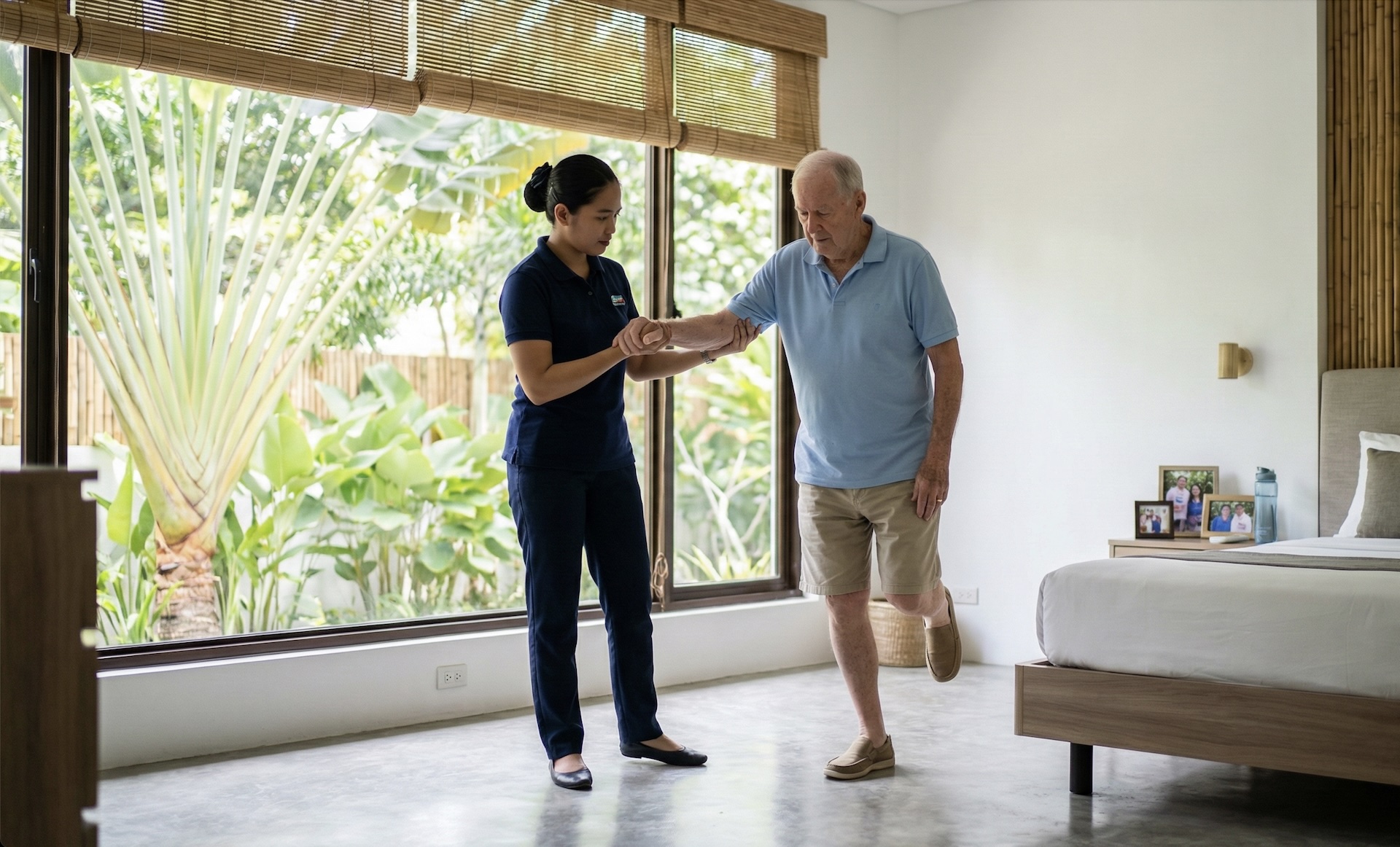
The cost difference isn't about lower standards - it's about labor market economics. Healthcare professionals across Southeast Asia earn competitive local salaries, but they're a fraction of U.S. healthcare wages. That savings gets passed directly to families.
What $1,500-$4,000/Month Actually Buys
Southeast Asian personalized care packages typically include:
- Registered nurses providing hands-on care - not just supervision. Staff-to-resident ratios from 1:1 to 1:5 (compared to 1:12 or 1:20 in U.S. facilities)
- Private accommodations (villa-style rooms, not hospital wings)
- All meals (no "meal plan" upcharges)
- Medical supplies (IV management, wound care, PT - included)
- No hidden fees for incontinence care, extra baths, or hand-feeding
- Dedicated 1:1 RN care available for highest-need residents requiring skilled nursing
search For Highest-Intensity Care Needs
Advanced dementia or complete ADL dependence? True 1:1 dedicated nursing is available for $3,000-$4,000/month - still a fraction of U.S. costs.
How Far Does $24,000 Stretch?
The same budget, dramatically different durations
The Objections (Let's Address Them)
"But it's so far away. How would I visit?"
This is the hardest part, and it's valid. Round-trip flights from the U.S. to Manila run $800-$1,200. For families in California, it's a 14-hour flight. Bangkok is 17-20 hours from the East Coast; Kuala Lumpur similar. That's not nothing.
But compare it to: visiting a parent in a facility two hours away where you watch them parked in front of a TV, waiting for a CNA who's 30 minutes behind schedule.
Distance is measured in more than miles.
"What about the language barrier?"
English is an official language in the Philippines. Filipino nurses train in English-medium programs and many have worked in U.S. hospitals. Communication is typically not an issue.
In Thailand, many expat-focused facilities employ English-speaking staff, though proficiency varies. Malaysia has widespread English as a second language, making communication straightforward.
"Is it safe? What about medical emergencies?"
Reputable facilities are located near hospitals and have established protocols for emergencies. Thailand, the Philippines, and Malaysia all have well-developed healthcare systems. Thailand is a global medical tourism hub, the Philippines exports nurses worldwide, and Malaysia has JCI-accredited hospitals.
"Will the culture be too different?"
Filipino culture centers on respect for elders, which translates to attentive, relationship-based care rather than task-focused routines. Where American facilities struggle with staffing shortages and burnout, caregivers in the Philippines view elder care as a profession worthy of dedication.
Thai culture is similarly rooted in respect for elders — the concept of kreng jai (consideration for others) shapes caregiving. Malaysian facilities blend Malay, Chinese, and Indian cultural influences, creating a welcoming environment for diverse backgrounds.
Who Should (and Shouldn't) Consider This
This Model Works Best For:
- Families spending $10,000+/month on U.S. care with no end in sight
- Parents who need dedicated nursing supervision (not just companionship)
- Situations where memory care or advanced dementia requires constant eyes-on supervision
- Families geographically spread out anyway (siblings in different states)
- Parents who are adaptable and not deeply rooted to a specific community
This Probably Isn't Right If:
- Your parent has strong daily connections to a local community
- Family visits multiple times per week and that's feasible long-term
- The parent is in early-stage decline and may stabilize with part-time help
- The idea of international care creates more anxiety than financial relief
Is Overseas Care Right For You?
Consider these four factors
If most of your answers are YES, exploring Southeast Asian care options could provide better quality care at a fraction of the cost.
The Uncomfortable Truth About Elder Care in America
No one wants to "send their parent away." The guilt is real.
But continuing to frame overseas care as "giving up" ignores the math: most American families cannot afford $24,000/month. They can't even afford $10,000/month for nursing homes indefinitely.
When the alternative is:
- Draining retirement accounts
- Taking out loans against the house
- Watching a parent receive distracted, understaffed care while you go broke
...then choosing high-quality, personalized care at a sustainable price isn't abandonment. It's responsible decision-making.
Your Next Steps
The goal isn't to convince every family this is right for them. The goal is to make sure you know this option exists before you've already spent $200,000 on care that's draining your savings without providing the personalized attention your parent deserves.
Frequently Asked Questions
How much does 24/7 home care cost per month?
The national median cost for 24/7 in-home care is $24,006 per month based on $33/hour rates. Costs vary by location, ranging from $24-$43 per hour depending on your state.
Does Medicare cover 24-hour home care?
No. Medicare covers medical home health services like skilled nursing visits and physical therapy, but does not cover custodial care (bathing, dressing, supervision) needed for 24/7 home care.
What are Medicaid income limits for home care?
Medicaid long-term care income limits range from $1,000-$3,000 per month depending on your state, with asset limits of $2,000 for individuals ($3,000-$4,000 for couples).
How much does nursing home care cost in Southeast Asia?
Costs vary by country: Thailand $2,000-$4,000/month, the Philippines $2,000-$3,500/month, and Malaysia $1,000-$2,500/month. All offer personalized care with 1:1 to 1:5 staff-to-resident ratios — with registered nurses providing hands-on care, not just supervision. Dedicated 1:1 RN care is available for highest-need residents.
Share This Article
Help other families understand their care options and costs.
Sources
- A Place for Mom, 2025 Cost of Long-Term Care Report
- Genworth Cost of Care Survey, 2024
- Centers for Medicare & Medicaid Services, 2025 Home Health Rate Schedule
- Federal Register: CMS Final Rule - Repeal of Minimum Staffing Standards (December 2025)
- HHS ASPE: Nurse Staffing Estimates in US Nursing Homes (May 2024) — Analysis showing 70% of facilities below nurse aide minimums
- Weill Cornell Medicine, "Private Equity Ownership of Nursing Homes Linked to Lower Quality of Care," 2021
- University of Chicago Booth School, "When Private Equity Takes Over Nursing Homes," 2020