A Place for Mom Alternatives: What They Don't Tell You About Senior Care Referrals
You searched for help with your parent's care. Within 24 hours, your phone wouldn't stop ringing. That's not a glitch—that's the business model. Here is what the senior care referral industry, now under massive federal and state scrutiny, doesn't want you to know.

Maybe you filled out a form online, or called a number that promised free senior living advice. You were worried about your parent. You needed help.
What you got was your contact information sold to the highest bidders. Those calls aren't from caring advisors—they're from sales representatives at nursing homes who paid for your data, competing to close you before the other facilities do.
You became a "lead"—a data point worth up to $15,000 in total customer acquisition costs. If you feel frustrated, even betrayed, you're not alone. And in 2026, regulators are finally catching up.
How Senior Living Referral Services Actually Work
In 2026, the largest senior living referral services—A Place for Mom, Caring.com, SeniorAdvisor—continue to present themselves as free, helpful resources. And they are free to you. But each placement generates up to $15,000 in hidden marketing costs that get baked into your parent's monthly bill.
You're not the customer. The nursing homes are. You're the product.
The Lead-to-Cash Pipeline
- 1
You Fill Out a Form
Your information—name, phone, email, care needs, budget, location—is captured and packaged into a "Lead Card."
- 2
Your Lead Card is Auctioned
Typically 3-5 nursing homes receive your information simultaneously, each paying $200-$500 just to see your data.
- 3
Facilities Race to Contact You
Speed matters—the first to reach you has the best chance of closing the sale. This is why you get flooded with calls within hours.
- 4
Tiered Commissions & Bonuses
Facilities pay one full month's rent ($3,000-$8,000+) as base commission—plus "quick placement" bonuses of $500-$1,500 for move-ins under 30 days.
This model creates four problems that directly harm families:
The Four Problems With Referral Agencies
Problem 1: You Only See Paying Partners
Referral services only recommend facilities that pay them referral fees. Independent facilities, smaller operators, and many non-profit care homes don't appear—not because they provide worse care, but because they don't pay for leads.
A Washington Post investigation found major referral services showed families only a fraction of licensed facilities in their areas.
Problem 2: Commission-Driven Advice
When an advisor's income depends on placing you in a facility—any facility—their incentives don't align with finding you the best facility. They align with finding you the fastest facility.
Former referral service employees describe quotas, pressure to close quickly, and bonuses tied to placement volume rather than quality. Some states now require licensing as "Senior Placement Brokers"—a recognition that these are sales roles, not advisory roles.
Problem 3: Quality Isn't Part of the Algorithm
Referral services don't filter out facilities with poor inspection records, staffing violations, or low Medicare quality ratings. If a facility pays for leads, it appears in recommendations—regardless of whether state inspectors found serious deficiencies.
A 2025 investigation found over a third of top-recommended facilities had documented quality violations.
Problem 4: The "Dark Pattern" Trap
In 2025, the FTC reached an $8.5 million settlement with Care.com for deceptive practices including misleading marketing, hidden fees, and making it difficult to cancel services.
The referral industry uses "dark patterns"—design choices that manipulate users into actions they didn't intend. Forms that auto-share your data. Cancellation processes buried in fine print. The FTC is watching.

The Texas Disclosure: New State Laws Protecting Families
Growing awareness of these problems has led to landmark legislation. Texas is leading the charge with the strongest disclosure requirements in the nation.
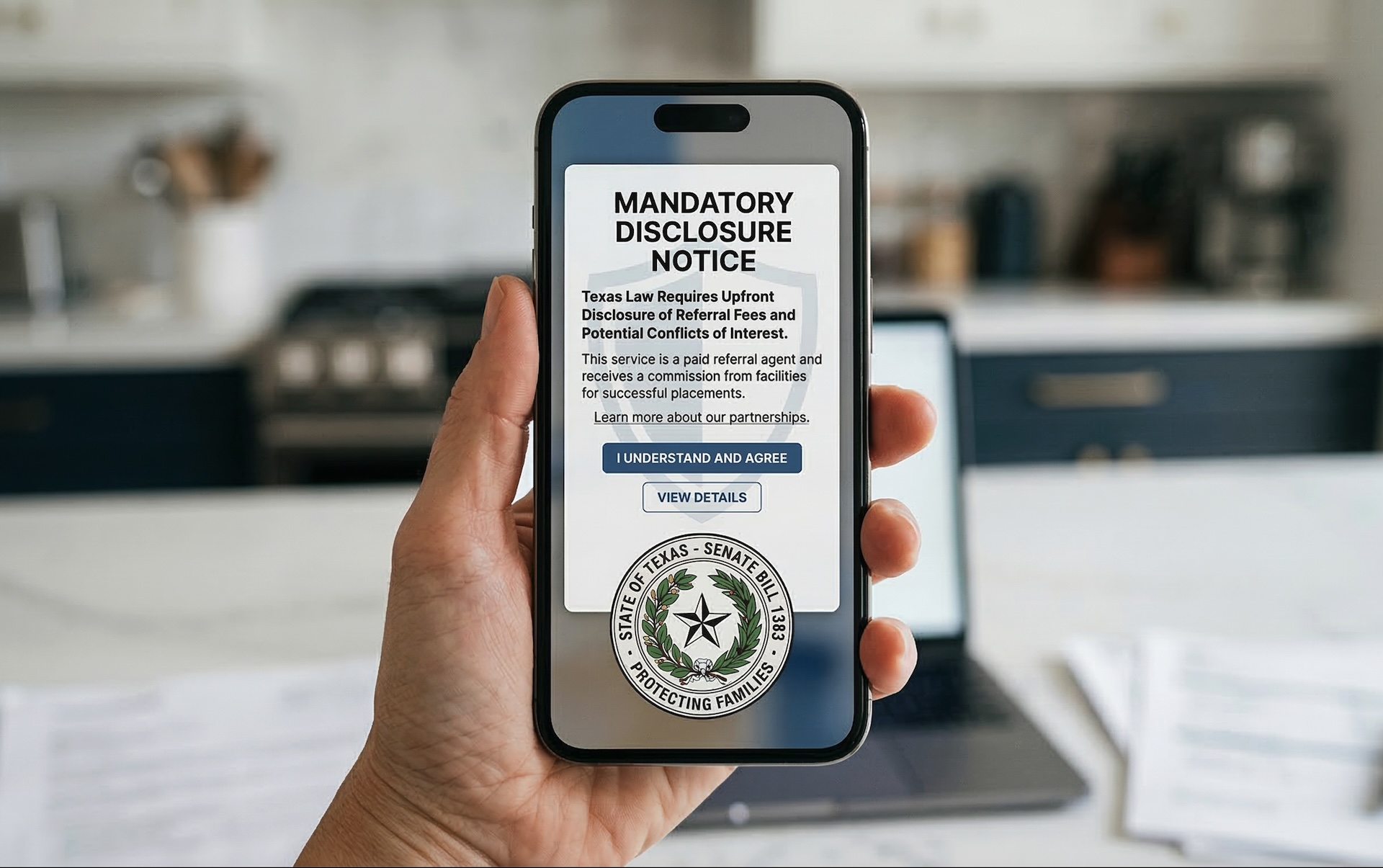
Texas Senate Bill 1383 (Effective September 2025)
Senior placement agencies in Texas must now provide written disclosure before any services, including:
- check_circle They receive compensation from facilities they recommend
- check_circleThe exact amount of compensation they receive per placement
- check_circle Whether facilities were excluded because they don't pay referral fees
- check_circle Your contact information will be shared with multiple facilities
info Texas residents: If a referral service doesn't provide this disclosure, they're violating state law.
Other States Joining the Movement
Maryland (2025)
Requires disclosure of financial relationships with recommended facilities and prohibits misleading "best match" claims.
California (2025)
Expanded disclosure requirements under the California Referral Agency Consumer Protection Act, including fee transparency.
The Private Equity Red Flag
Beyond referral agencies, there's another hidden threat in the senior care system: Private Equity ownership.
Annals of Internal Medicine (September 2025)
Private Equity firms acquire nursing homes, cut costs (primarily staff), extract profits, and often leave facilities financially weakened. The human cost: higher mortality rates and worse care quality.
How to check: Ask any facility directly: "Is this facility owned by a Private Equity firm?" Look for parent companies with names like "[Name] Healthcare Partners" or "[Name] Senior Living Holdings."
Five Neutral Alternatives to Referral Agencies
If you want to avoid the referral agency trap, you have five main options—each with trade-offs. These are truly neutral: they don't take commissions from facilities.
Area Agencies on Aging (AAAs)
Free (Tax-funded)Area Agencies on Aging are federally-mandated, locally-operated agencies that provide free, unbiased information about senior care options. They exist in every county in America.
AAAs don't receive commissions from facilities. They're funded by taxpayers to help you—making them legally neutral.
Find your local AAA at eldercare.acl.gov open_in_newLong-Term Care Ombudsmen
Free (Tax-funded)Ombudsmen are resident advocates who handle complaints, investigate quality issues, and can tell you which facilities have problems.
They know which facilities have chronic issues because they receive the complaints. This is insider knowledge referral agencies don't—and won't—share.
Find your state Ombudsman at ltcombudsman.org open_in_newDIY Research
Free (your time)You can research facilities directly using public databases that show all licensed options—not just paying partners.
search Medicare Care Compare
CMS updated their rating formula in July 2025 to better reflect staffing levels and quality outcomes. Star ratings now more accurately predict care quality.
medicare.gov/care-compare open_in_newapartment State Licensing Databases
All licensed facilities including assisted living communities not Medicare-certified. Search "[your state] assisted living license lookup."
description State Inspection Reports
Violations, complaints, and enforcement actions that never appear on referral websites.
Hire a Geriatric Care Manager
$100-200/hourGeriatric Care Managers (also called Aging Life Care Professionals) are licensed social workers, nurses, or gerontologists who work directly for families—not facilities.
Because you pay them directly, their only incentive is to find you the best fit. They'll assess needs, research all options, accompany you on tours, and help negotiate pricing.
International Care (Philippines & Thailand)
from ~$1,600/moThis option isn't for everyone. But for some families, it's the escape hatch from a broken system.
The fundamental problem with U.S. senior care isn't just referral agencies—it's the underlying economics. American nursing homes now average $10,600/month (Genworth 2025) while providing staffing ratios of 1 aide to 8-15 residents.
Philippine facilities operate on fundamentally different economics. Lower cost of living means facilities can provide dedicated, personalized care at a fraction of U.S. costs—with registered nurses providing hands-on care, not just supervision.
SRRV Visa Update (2025): The Philippine Retirement Authority now offers the SRRV visa with a reduced deposit of $15,000 for pension holders—down from previous requirements. This provides a legal pathway to long-term residence.
Thailand
Chiang Mai: Southeast Asia's established memory care hub. Unlike the Philippines where memory care is a growing sector, Chiang Mai has developed a recognized specialty in dementia and memory care—with dedicated facilities and specialist networks already in place.
- Healthcare infrastructure: 62+ JCI-accredited hospitals—the highest concentration in Southeast Asia. Bangkok: Bumrungrad, Samitivej; Chiang Mai: Bangkok Hospital (JCI-accredited)
- Costs: ~$1,500–$2,500/mo for assisted living; $2,000–$4,000/mo for skilled nursing and memory care
- Staffing: 1:1 to 1:4 ratios; premium facilities offer 3 dedicated caregivers per resident
- Visa options: O-A Retirement Visa (800,000 THB / ~$22,000 deposit) or LTR Wealthy Pensioner Visa (10-year term)


Comparing Your Options
Here's how the different approaches stack up:
| Factor | Referral Agencies | AAA / Ombudsmen | Care Manager | International (PH/TH) |
|---|---|---|---|---|
| Cost to You | "Free" (Hidden $10k-15k) | Free (tax-funded) | $1,000-4,000 | from ~$1,600/mo |
| Who Pays Them | Facilities | Taxpayers | You directly | You directly |
| Bias Level | Extremely High | None (Neutral) | Low | Low |
| Staffing Ratio | 1:8 to 1:15 | N/A | Helps evaluate | 1:1 to 1:5 (PH) / 1:1 to 1:4 (TH) |
| Quality Check | Minimal / Paid | Official Complaints | Deep Vetting | Personal Vetting |
† Philippines and Thailand: available now.
The Texas Test: Three Questions to Ask Any Service
Whether you're in Texas or not, use the Texas SB 1383 disclosure requirements as your benchmark. Any ethical service should be willing to answer these questions:
"Are you compliant with the Texas SB 1383 disclosure standards?"
If they don't know what this is, they're not following best practices. If they refuse to provide the same disclosures, ask why.
"Is this facility owned by a Private Equity firm?"
A direct question that reveals ownership structure. PE-owned facilities have documented higher mortality rates (+13%) and lower staffing.
"Are you receiving a 'quick placement' bonus for my parent?"
Exposes the speed incentive. If yes, understand their motivation is to place fast, not to place well.
Considering International Care Options?
If you're open to exploring care in the Philippines or Thailand—where facilities offer 1:1 to 1:5 staff ratios at from ~$1,600/month compared to U.S. averages of $10,600/month with 1:15 ratios—we can help you evaluate whether it's right for your family.
🇵🇭 Philippines: SRRV Visa ($15,000 deposit for pension holders); from ~$1,600/mo; 1:1 to 1:5 staffing
🇹🇭 Thailand: O-A Retirement Visa; Chiang Mai memory care hub; from ~$2,000/mo
No sales pressure. No lead selling. Just honest guidance about options most families don't know exist.
Get a Free Consultation arrow_forwardFrequently Asked Questions
How do senior living referral services make money?
Referral services like A Place for Mom receive commissions from facilities when you move in—typically equivalent to one full month's rent ($3,000-$8,000+). With quick placement bonuses of $500-$1,500, the total customer acquisition cost can reach $10,000-$15,000 per resident. They only recommend facilities that pay them referral fees.
Why do I get so many calls after requesting senior care help?
Your contact information is sold to multiple facilities (typically 3-5) simultaneously as a "Lead Card." Each facility races to contact you first because speed improves their chances of closing the sale—and they may receive bonuses for placements under 30 days.
What are alternatives to senior living referral agencies?
Five neutral alternatives exist: Area Agencies on Aging (free, tax-funded), Long-Term Care Ombudsmen (200,000+ cases handled in 2025), DIY research using Medicare Care Compare (updated July 2025), Geriatric Care Managers ($100-200/hour), or international care options in countries like the Philippines or Thailand with staffing ratios of 1:1 to 1:5 at from ~$1,600/month.
Do referral services check facility quality ratings?
A 2025 investigation found 37% of "highly recommended" facilities had serious violations. Most referral services don't filter out facilities with poor inspection records. If a facility pays for leads, it appears in recommendations regardless of quality.
What is Texas SB 1383 and how does it protect families?
Texas Senate Bill 1383, effective September 2025, requires senior placement agencies to disclose in writing that they receive compensation from facilities, how much they receive, and whether facilities were excluded for not paying fees. This is the strongest disclosure law in the nation.
Are nursing homes owned by Private Equity firms worse?
According to a September 2025 study in the Annals of Internal Medicine, nursing homes acquired by Private Equity firms showed a 13% increase in mortality rates and 13% staffing cuts compared to non-PE facilities.
Is Thailand a good option for dementia care?
Thailand's Chiang Mai region has become Southeast Asia's recognized memory care hub, with established specialist facilities and dedicated dementia care networks. Premium Thai facilities offer staffing ratios of 1:1 to 1:4, with some providing 3 dedicated caregivers per resident. Thailand's 62+ JCI-accredited hospitals provide world-class medical backup. Costs run ~$2,000–$4,000/month for memory care, compared to ~$6,500–$7,000/month in the U.S. BCT plans to include Thailand facilities in Q2 2026. Note: Unlike the Philippines, English capability varies by facility—always verify before selecting.
Sources & Further Reading
- gavel Texas Senate Bill 1383 (Effective Sept 2025): capitol.texas.gov
- account_balance FTC vs. Care.com (2025): $8.5M Settlement for deceptive practices
- science Annals of Internal Medicine (Sept 2025): Private Equity and Nursing Home Mortality Study
- analytics CMS Quality Rating Update (July 2025): cms.gov
- analytics Genworth Cost of Care Survey 2025: genworth.com
- link Philippine Retirement Authority (SRRV Visa): pra.gov.ph
- link Medicare Care Compare: medicare.gov/care-compare
- link Aging Life Care Association: aginglifecare.org
- link Eldercare Locator (Find AAAs): eldercare.acl.gov
- link Long-Term Care Ombudsman Program: ltcombudsman.org
- link ExpatDen Retirement Home Thailand 2025: expatden.com
- link Siam Legal Thailand Retirement Visa 2025: siam-legal.com